A few comments to document here what I said in yesterday’s ZIP sync (11 August), but in more detail.
This is a poll, not a vote
There is no ZIP that approves making Zcash protocol decisions by vote or that specifies how to do so (and also no Zcash Governance Proposal or whatever would replace ZIPs for that purpose). The only ZIP that mentions coinholder polling, ZIP 1016, has this in its Non-requirements section:
Any changes to Zcash protocol governance, specifically what changes are made to consensus node software, are outside this proposal’s scope.
Anyone is free to carry out a poll. Calling it a “vote” misleads about its force.
Sprout
Q3 includes a new option relative to the previous poll: “Do not set a v4 transaction deprecation date.”
First, this has a wording error. ZIP 2003 does not propose to deprecate v4 transactions, it proposes to disallow them:
This proposal disallows v4 transactions. The v5 transaction format introduced in the NU5 network upgrade [ZIP 225] does not support Sprout, and so this will have the effect of disabling the ability to spend Sprout funds.
“Disable” (as in the question “When should v4 transactions be disabled?”) is a synonym; “deprecate” is not. This creates confusion about the meaning of the question and should be fixed (e.g. “Do not set a date to disable v4 transactions.”) if the option is retained at all.
However, I want to emphasize the absolute necessity of removing Sprout from the protocol. The reasons to do so have only become more urgent since ZIP 2003 was proposed and also since the last NU7 sentiment poll. For example, zcashd 6.12.0 fixed a critical consensus bug in which Sprout JoinSplit proofs were not being validated in blocks sent directly to a zcashd peer, due to a misimplemented caching optimization. This proves incontrovertibly that I was right about Sprout’s attack surface being an unacceptable risk.
zcashd is no more (and gone with it is the last wallet that supported Sprout), but zebrad also depends on Sprout code that frankly does not come up to our present standards. The risk of (potentially AI-assisted) bug-hunters finding flaws in it is real and significant. The Sprout turnstile is essential, but if there were a turnstile violation or other visible exploit of the Sprout protocol, that could have a severe effect on confidence — probably affecting ZEC’s fiat value by far more than the nominal amount in the Sprout pool (22,621 ZEC, or USD 11.3m @ USD 500/ZEC).
That interacts with the characterization of this polling as a “vote” rather than an advisory poll. I strongly believe that it would be neither fair nor right to expose all ZEC holders to unnecessary risk on the say-so of a few obstinate large holders.
Issues affecting the NSM questions
“Donated funds”
Funds are removed from circulation by the mechanism of ZIP 233. That wording was carefully chosen and is what should be used in all governance discussions. The wording of Q1 should be changed accordingly. Also, “fee reissuance” is simply incorrect. What is eventually reissued is only and exactly the amount removed from circulation. That must include at least 60% of fees in each block.
Potential NSM Reissuance Start Dates
Q2 currently has the following options:
- As soon as possible after NSM activation.
- After the fourth halving (around 2032).
- Abstain.
But it had already been agreed that the first oppportunity for the smoothing to activate would be the point at which the smoothed issuance curve, excluding reissuance, intersects the stepped one — roughly 2.23 years after the second halving, which coincided with NU6 on November 24, 2024. That is 188 days from now, roughly February 17, 2027 (the estimate has drifted by only ~2 days due to block time variation). Here is the proposed issuance graph, as specified in ZIP 234 and calculated by daira/nsm-simulator:
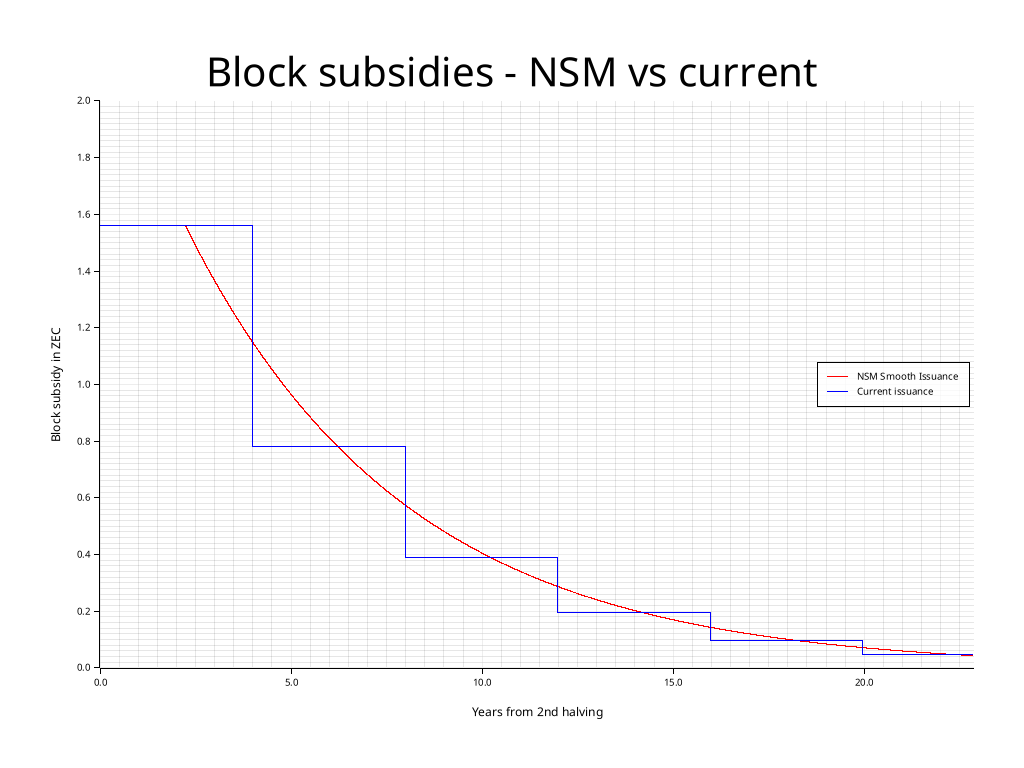
This is needed to satisfy at least three of the Requirements of ZIP 234, namely:
- […]
- Block subsidies approximate a continuous function.
- […]
- Decrease the short-term impact of the deployment of this ZIP on block subsidy recipients, and minimize the potential reputation risk to Zcash of changing the block subsidy amount.
- The immediate change in issuance when this mechanism activates should be minimal.
There would be significant negative ZEC monetary policy implications if the issuance were to abruptly increase at activation, which is why it was designed this way.
The next date after that at which the smoothed issuance curve intersects the stepped one is in February 2031 (not at the fourth halving which is expected in November 2032).
Taking into account the last item as well, Q2 should read:
Q2 (NSM Reissuance Start Date)
NSM has prior coinholder approval. This question concerns the start of reissuance of funds removed from circulation (which includes at least 60% of total fees).
When should NSM reissuance of funds removed from circulation begin?
- The next point at which the smoothed issuance curve intersects the stepped one (February 2027).
- The point at which those curves intersect one halving later (February 2031).
- Abstain.
Transaction format change caveat and consequences for NSM
The note about transaction format changes above needs to be visible above the question list. People usually read things sequentially, and a comment tucked away in this thread is not enough.
In particular, this note contradicts what the poll says in Q5, and the conflict must be fixed one way or another. Q5 currently says:
NU7 will include NSM fee recycling, […]
That can’t happen if NU7 doesn’t include a transaction format change. Also, no funds removed from circulation will be recycled anyway until February 2027 at the earliest, as I pointed out above. So, delete “NU7 will include NSM fee recycling” from Q5, because it won’t.


