Request for ZCAP Members' Thoughts on Moving from HELIOS to SIV for Future Voting

Hello ZCAP members,

ZF would like to open a discussion about whether we should consider migrating from the HELIOS voting platform to Secure Internet Voting (SIV) for future ZCAP voting.

Over the years we’ve encountered various challenges and limitations with Helios, including a lack of support, which motivated us to explore alternative solutions. For context, Helios was created 17 years ago by then-graduate student Ben Adida (who now leads VotingWorks, a non-profit physical voting system vendor).

After some initial research about SIV, we recently met with the founder to learn more and were impressed both by how closely the project’s values align with our community as well as the strengths of the platform itself.

Here’s some additional background to inform our discussion:

Community Fit & Ambitions

SIV was designed with cryptographers and digital democracy in mind, drawing on principles of transparency, verifiability, and privacy. The team has real motivation: they want engagement, feedback, and ideas from projects like Zcash to create even better voting solutions tailored to our needs.

Example Ballot

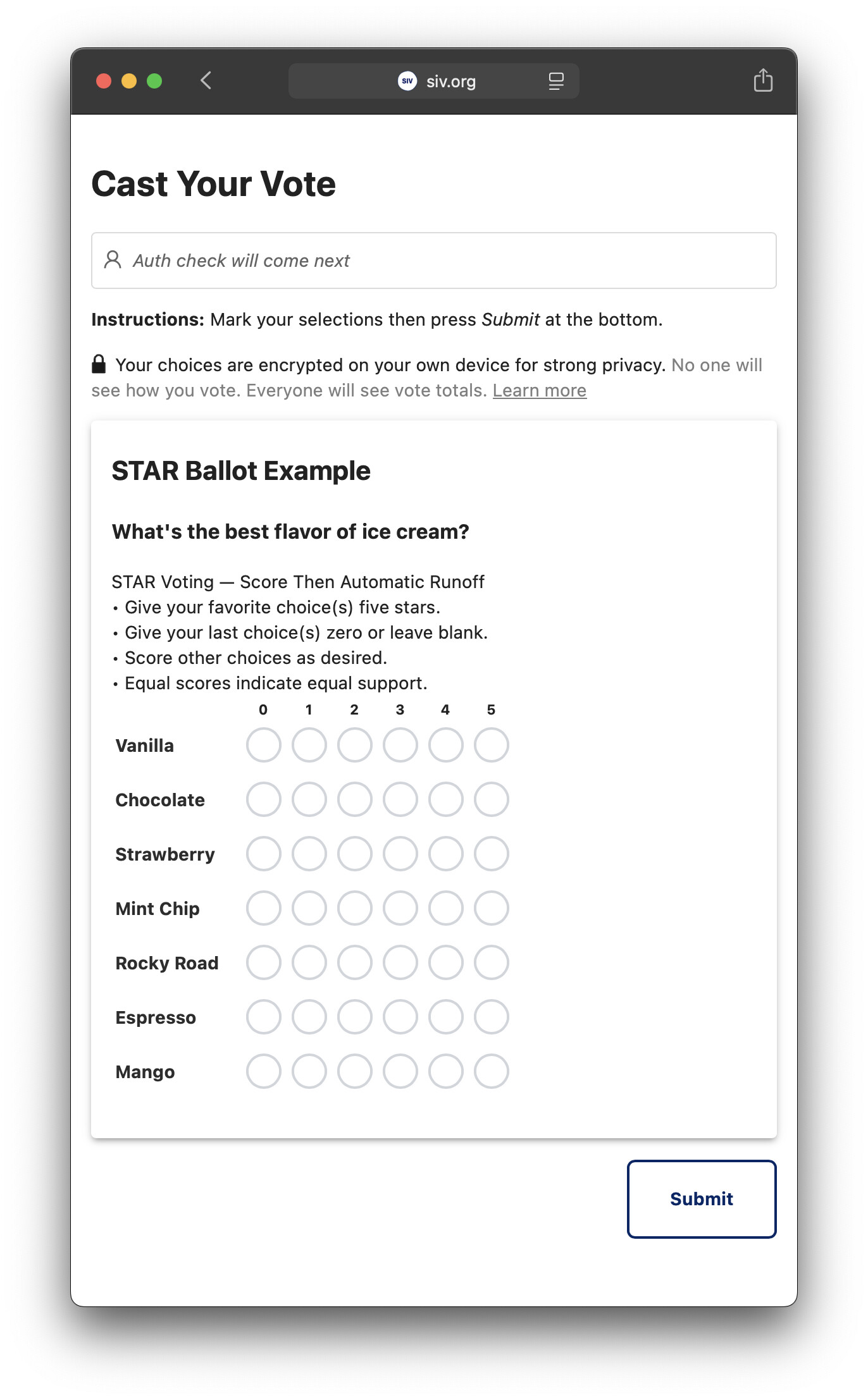
This is a sample ballot you can click through to learn more about the voting experience: Cast Your Vote. This one uses an open-registration format, so it asks for name and email address after voting, but for ZCAP votes we would use the list of members.

Who’s Behind SIV?

David Ernst is a long-time Zcasher. He ran a Zcash miner during the 2017 launch week and in 2022 he spoke with @zooko in person and received some “much-appreciated advice.” A “huge amount of the work SIV has done is inspired by Matthew Green.”

David is passionate about both serving and learning from dedicated communities like ours and is genuinely excited about a Zcash collaboration. The SIV team includes 3 full-time employees and 16 contributors.

Elements of his official bio:

David Ernst is the founder and CEO of SIV. A security engineer and cryptographer by trade with a background in mathematics and philosophy. In 2018, he ran for office in California as a Liquid Democracy candidate, and has since led pilots, published educational materials, and advised governments and organizations on participatory models. In 2020, David started SIV.org, where he works to achieve a zero-trust, software-independent, and voter-verifiable digital voting protocol, to improve voting accessibility and lay the foundation for less corrupt, more representative democracy models. His approach blends technical rigor with a long-standing interest in how groups can make wise decisions together, free of group-think or peer-pressure.

Platform Features & Support

  • High Level Protocol Overview: siv.org/protocol
  • Technical documentation of how SIV works: docs.siv.org
  • Claimed security model: Even if the worst actors are running the election infrastructure, anyone, especially voters, but also independent observers, can verify for themselves whether an election was run fairly and correctly, or not.
  • Open source: Closed source for 4 years, has been OS for 1 year now. Main SIV source code.
  • Proven at scale: Has powered real-world elections, such as the Utah House race for Celeste Malloy.
  • Easy verifiability: for voters to check if their private vote is correctly counted, without requiring advanced cryptographic knowledge.
  • Advanced security: Includes anti-vote-selling and coercion-resistance tools, privacy protectors like threshold-key mechanisms (t of n).
  • Participatory budgeting: Polling option allows voters to propose allocation of funds across multiple proposals then normalizes the outcome while still allowing each specific submission to be viewed without attribution.
  • Ongoing support: Small but very responsive support team that is willing to be very hands-on during the initial implementation to be sure everything goes smoothly.

Let’s Discuss!

How do you feel about moving from HELIOS to SIV for future ZCAP voting? Please share your thoughts. If there’s strong interest, ZF will invite David for an AMA as a next step.

24 Likes

Super cool, would love to experiment! :student: :shield:

4 Likes

This looks very interesting; the one thing that I haven’t been able to find quickly in the documentation is what voting methods are supported. In my quick read over the docs, I couldn’t find anything about the “Participatory budgeting” feature; can someone point me to more details? What systems are supported apart from plurality-winner voting?

1 Like

Hi all— this is David from SIV.org here. Wonderful to connect with everyone.

As @ZcashFoundation mentioned, I’d like to think we share so many goals— easy-to-use + verifiable + privacy-respecting digital infrastructure for civil society. :smiling_face_with_sunglasses:

From @nuttycom:

This looks very interesting; the one thing that I haven’t been able to find quickly in the documentation is what voting methods are supported. In my quick read over the docs, I couldn’t find anything about the “Participatory budgeting” feature; can someone point me to more details? What systems are supported apart from plurality-winner voting?

Out of the box, right this second, here are the ballot types already supported:

The ZCash Sample Vote here includes an example of how the Participatory Budgeting UI works for voters. And here’s an example of what Participatory Budgeting results look like (from a cool vulnerability-hunting contest we did at DEF CON last year).

One significant advantage here of the SIV architecture vs Helios is that (last time I checked) Helios adds up all the encrypted votes while they’re still encrypted (“homomorphic sums”), and then only decrypts the final tallied results. SIV on the other hand uses a related but slightly different operation, “homomorphic reencryption”, to power an anonymizing mixnet, then decrypts and publishes all the individual anonymized votes. This is much more analogous to paper voting, where ballots get filled out, then anonymized, then all individually re-countable.

This makes it much easier to support new tallying methods, because the tallying can all happen in plain Javascript, client-side, rather than needing to adapt and execute it within the homomorphic-encryption space.

Everyone can personally recount the results themselves— we actually do this by default, every client viewing the results page re-tallies the votes, for extra confirmation. This also makes it much more feasible to catch any bugs that slip in to new tallying algorithms.

So, for example, the screenshot above shows “Ranked Choice (ballot design) — IRV (tallying method)”, but some people last year ran a “Ranked Choice — Ranked Robin” election, which is much more spoiler-resistant than IRV (IRV unfortunately is really just a sequential set of Choose-Only-One, and still runs into the Spoiler Effect, albeit less often than Choose-Only-One).

Similarly, another group of users was able to add support for Multi-winner IRV in just a single afternoon, sent in a PR for it (I helped get it over the finish line, but Josh Herr there did all the real work), and now everyone can benefit from being able to use it.

We’ve done some other pilot votes using Quadratic Voting, STAR Voting, head-to-head pairwise selections (tallied using ELO scores), and more, although these have yet to be properly merged in.

Hope this helps, cheers

12 Likes

This is fantastic to hear, thank you! I hope that STAR can be merged, because that’s a personal favorite of mine; it makes me really happy to know that SIV is taking better systems into account (and the fact that you’re aware of the IRV spoiler effect puts you heads and shoulders of many voting system advocates and advocacy groups out there.)

Two thumbs up, let’s do this.

6 Likes

Yes, non-polarizing voting methods are terribly under-appreciated.

From @nuttycom:

I hope that STAR can be merged, because that’s a personal favorite of mine

Good news—STAR Voting already works with SIV, since it uses a Score ballot, which we support. Here’s an example, and the ballot schema that created it.

SIV will automatically run the Scoring round, just not the Runoff round. But since all anonymized decrypted votes are published, election admins can still tally the runoff themselves. Would love to make this even more seamless with automatic runoff tallying :slightly_smiling_face:

4 Likes

I never liked Helios voting. It’s horribly (de)integrated with password managers and it’s probably thought for Corporate folks that have Zero computer abilities specifically in the part where they send you voting credentials over email.

I support anything that means getting rid of it.

4 Likes

Also I just saw this today: https://irishtechnews.ie/new-electronic-voting-platform-voter-anonymity

Thanks to Amber tweeting about it:


What prevents someone from sending their own ZEC to the public candidate address? Since the source is shielded, it would be undistinguishable from a real elector, wouldn’t it?

4 Likes

I think this proposal is great and interesting, and the SIV project looks very good.

Coincidentally, today we interviewed someone from Costa Rica in the Zcash community in Spanish who has developed a voting project that uses ZKP.

In his interview, he told us that a few years ago he attended a conference by Zooko, where he heard about ZKP, and became so interested in its implementation that he developed his own project, very similar to SIV.

Here is his website, because we also invited him to join the Zcash forum to get involved with the community and perhaps do some development.

I think replacing Helios with a better solution is a good idea.

5 Likes

Thanks a lot @gordonesTV . We are creating a private identity wallet using ZKPs and an on-chain voting system using such a wallet, here I send a couple of links to both projects, which are open source:

Please let me know if you want more information or questions about it.

2 Likes

I tested out the poll and can confirm chocolate is the best ice cream

3 Likes

Hello ZCAP, the SIV voting system is as cool as ice cream. What I particularly like about it is the flexibility it offers when voting as an ex-ballot counter. This concept is truly innovative and represents the future of voting.

Traditional elections can take days to count millions of votes, and human errors are inevitable. However, with this advanced voting technology that prioritizes privacy, the process becomes much more efficient and accurate.

Please replace Helios with SIV.org. The website layout is very professional, and based on David’s responses on the forum, the support will be top-tier. Thank you, David, for your significant contributions to Zcash and all the excellent work you’ve accomplished. This is truly a great voting system.

3 Likes

Hi everyone,

It’s great to see such strong support for exploring the use of SIV in the next ZCAP election. The feedback so far has been overwhelmingly positive. So, let’s move forward and give it a try!

The next ZCAP voting opportunity will take place no later than November. As we get closer to the date, we’ll share more details about how the process will work and what to expect.

As promised, we’ll also coordinate an AMA with @dsernst ahead of the vote. Stay tuned for details.

We’re excited to see how this new approach works in practice, and after the first vote, we’ll invite feedback to help guide future improvements. Thanks for being part of the conversation, and the experiment!

10 Likes

:loudspeaker: Submit Your Questions for David Ernst of Secure Internet Voting (SIV)!

Next week @alex_ZF will host a recorded call with @dsernst, founder of Secure Internet Voting (SIV). The discussion will include:

  • An overview of how the SIV platform works

  • Answers to some questions submitted by the community ahead of time

  • Discussion about how ZCAP might utilize SIV for future votes

This is a great opportunity to learn more about secure, privacy-respecting mechanisms for internet voting and explore how they may intersect with the Zcash ecosystem.

:speech_balloon: Drop your questions right here in this thread — we’ll pick some to discuss on the call!

5 Likes

Earlier today, @Alex_ZF hosted an AMA with @dsernst, founder and CEO of Secure Internet Voting (SIV.org), to discuss the future of digital democracy and secure online voting for ZCAP. The call explored how SIV’s open-source platform could meet our community’s growing needs for transparency, privacy, and verifiability.

:backhand_index_pointing_right: Watch the full recording here.

Discussion Highlights

  • Mission and inspiration behind SIV: SIV was founded to enable safe digital democracy by using modern technology to put the fundamental right to vote in citizens’ pockets, while maintaining rigorous security and privacy standards.

  • Technical challenges: Top hurdles include secure voter identification, malware prevention on voting devices, and defending against bribery or vote-selling. SIV uses advanced cryptography to balance authentication, privacy, and verifiability.

  • Transparency vs. privacy: SIV separates voter identity (known only to administrators) from the content of votes (kept private through encrypted mixnets and anonymization), giving voters confidence in both auditability and confidentiality.

  • Applying SIV to ZCAP polls: SIV offers streamlined processes for administrators and supports advanced voting methods, such as participatory budgeting and pairwise rankings, while enhancing privacy and integrity for ZCAP’s decentralized polls.

  • Ensuring transparency and integrity: SIV enables each voter to verify that their individual vote was counted, supports post-election audits, and allows result verification at any time—unlike most paper voting systems.

  • Unique features for ZCAP: The platform offers cryptographic verifiability, delegation options, and anti-censorship safeguards that align closely with Zcash’s values on privacy and auditability.

Get Involved

The synergy between SIV and ZCAP opens up new possibilities for secure, decentralized voting. Please share your questions, ideas, and suggestions in this thread to help guide the next chapter of ZCAP voting.

10 Likes

Following our recent collaboration with SIV engineers, we’re pleased to announce the completion of two new admin features, marking our readiness to utilize SIV for future advisory polls. These new capabilities include:

Customizable Voter Invitations

New tools were added allowing admins to customize invitation emails and ballots, using easy markdown. The admin can now also quickly see previews of the email and ballot designs before sending.

Mobile-Friendly Admin Access

The SIV management interface is now readily available on phones as a home-screen app, making it easy to monitor elections or set up private votes directly from mobile—not just desktop.


We invite you to try out SIV, contribute feedback, and help shape future voting features.

We’re grateful to the SIV engineering team for their hard work and dedication in adding these important features to support secure, accessible voting for the Zcash community.

11 Likes

What I hope for most, this ZCG election, is more ZCAP participation.

Hopefully the shiny new voting platform will be one more reason for ZCAP members to re-engage with the voting process.

1 Like

ZCG candidates have set out their positions (and taken questions).

So, now we just need ZCAP members to watch out for the voting notifications…

Remember, this time it’s not Helios to watch for, it’s SIV (like civilization).

2 Likes